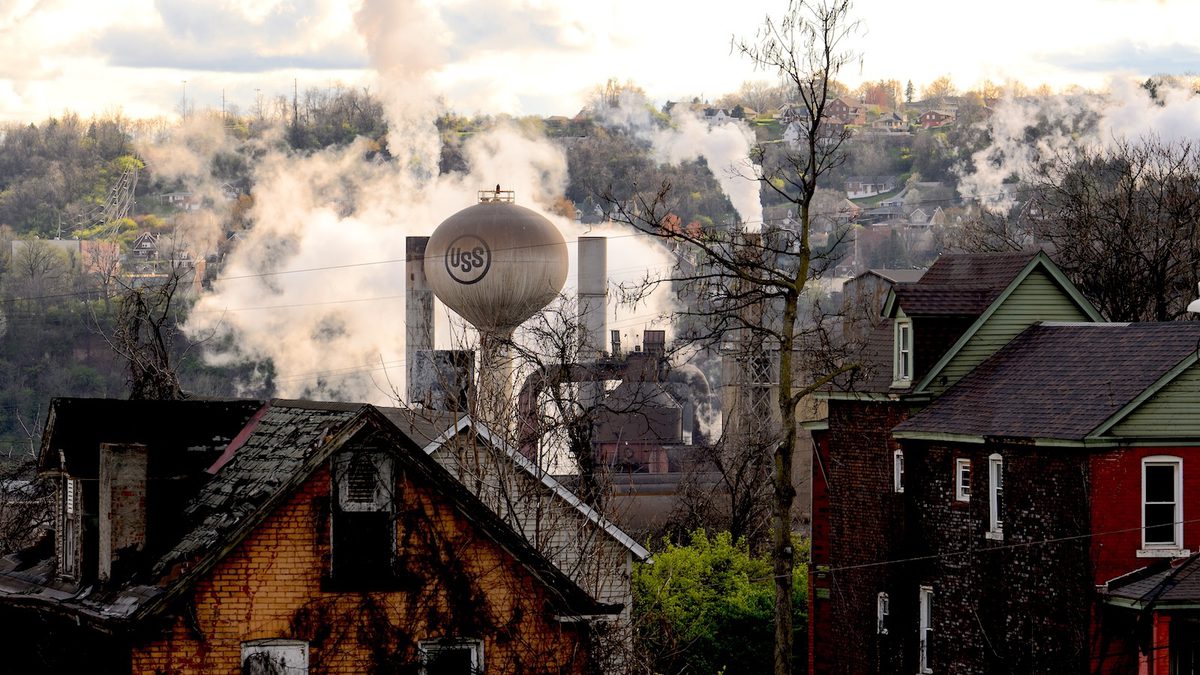
A Japanese steel giant has pledged billions in new investment in Pennsylvania’s Monongahela River Valley, raising hopes that it would clean up pollution from its steel mills in the region. But documents show that its plans to ramp up production will worsen local air quality.
As it runs north to Pittsburgh from its headwaters in West Virginia, the roughly 130-mile-long Monongahela River carves a winding path through a steep-walled basin dotted with small towns and forested hillsides. But the prettiness of this place, known to locals as the Mon Valley, belies a long history of pollution and a drawn-out battle for clean air.
In 1875, Andrew Carnegie opened his first steel mill along the river in Braddock, near Pittsburgh, launching more than a century of heavy industry. By 1901, Carnegie’s company had merged with others to become U.S. Steel. The Mon Valley was the epicenter of domestic steel production, and the air was thick with smog.
Between 1970, when the Clean Air Act was passed, and 2020, emissions of key air pollutants nationwide dropped by 78 percent. In the Mon Valley, however, improvement has been more halting. The American Lung Association’s 2026 State of the Air report ranked Allegheny County, which includes the Mon Valley, among the most polluted places in the nation, with failing grades for unhealthy ozone levels, spikes in exposure to fine particulate pollution, and chronic exposure to those fine particles throughout the year.
The public health impact is considerable: A study published in January in the Annals of Global Health found that in 2019 alone some 12 percent of adult deaths and more than 400 adverse birth outcomes in the greater Pittsburgh area were attributable to air pollution. Across Allegheny County, childhood asthma rates are about 11 percent, compared to a national average of 6.7 percent. But research led by Deborah Gentile, a pediatric allergist in Pittsburgh, found that for children living closest to the cluster of plants known as the Mon Valley Works, asthma rates were more than 22 percent.
According to the latest EPA records, a coking plant in the Mon Valley has violated the Clean Air Act for 12 consecutive quarters.
Now, the valley may be at an inflection point. Federal industrial policy has directed funding toward manufacturing nationwide, and the recent acquisition of U.S. Steel by the Japanese company Nippon Steel comes with a promise of billions in investment in the region and plans for a new manufacturing facility. But while Nippon is moving to curb carbon emissions from its global operations by embracing cleaner steelmaking technologies, in the already polluted Mon Valley it is doubling down on the use of coal, erecting a new hot strip mill that will drive up emissions of several pollutants, documents show.
“People recognize that the steel company has often lapsed in its promises to reduce emissions or invest in facilities,” said Patrick Campbell, executive director of the Pittsburgh-based Group Against Smog and Pollution (GASP). “They’re right to be deeply skeptical about what’s actually being invested in here.”
The air pollution problems originate at the Mon Valley Works, whose three steel mills emit particulate matter as well as benzene, ammonia, the respiratory irritant sulfur dioxide, and hydrogen sulfide, a flammable gas with a strong rotten egg smell.

Monessen, Pennsylvania, a town on the Monongahela River and site of a coking plant.Andrew Lichtenstein / Corbis via Getty Images
The Edgar Thomson Steel Works, in Braddock, uses massive blast furnaces to heat raw elements into molten steel. As of the Environmental Protection Agency’s last compliance monitoring a year ago, the plant had violated the Clean Air Act for nine straight quarters.
Just upriver in Clairton, the Clairton Coke Works uses huge ovens called batteries to bake coal at high temperatures to produce a purified fuel called coke that is used to run blast furnaces. The process creates emissions of both particulate matter and noxious gases, which are directly responsible, Gentile said, for asthma and other health issues.
“There’s tons of data linking [air pollution] to early deaths in adults, not to mention all the respiratory diseases including lung cancer and even [chronic obstructive pulmonary disease],” she said. “It can cause heart failure, arrhythmias, strokes. It’s also linked now with neurologic problems.”
The Clairton plant, according to EPA data last recorded in July 2025, had violated the Clean Air Act during the preceding 12 quarters. According to Allegheny County Health Department data, the plant is the source of more than 72 percent of the entire state’s hydrogen sulfide emissions and almost 93 percent of the county’s. Between March 2022 and November 2023, hydrogen sulfide levels at the monitor closest to the coke works exceeded the state standard of 5 parts per billion 159 times. In an enforcement order, the county noted that more than half of those exceedances were high enough to be considered of “major severity.”
Air quality monitors in the Mon Valley routinely record spikes of particulate matter, ozone, and sulfur dioxide that exceed federal thresholds.
The effects of air pollution are intensified by the valley’s topography, explains Albert Presto, who researches pollutant emissions in western Pennsylvania and is the director of Carnegie Mellon’s Center for Atmospheric Particle Studies. The factories’ stacks, he said, don’t reach above the rocky walls that flank the river. The area is also prone to inversions, in which the valley floor cools rapidly while warm air above acts like a lid. “That cooler air can get stuck down near the ground,” Presto explained, trapping pollutants with it.
Over the past 20 years, Presto said, pollution controls and the closing of four batteries at the Clairton Coke Works have contributed to a slow but significant reduction in the overall amount of particulate matter, ozone, and especially sulfur dioxide being released by the Mon Valley steelmaking facilities. “Mon Valley facilities have achieved environmental compliance rates exceeding 99 percent,” a U.S. Steel spokesperson wrote in response to questions. But air quality monitors operated by Allegheny County still routinely record spikes and hourly readings of particulate matter, ozone, and sulfur dioxide that exceed federal safety thresholds.
In mid-2025, Nippon officially acquired U.S. Steel in a deal that was previously blocked by the Biden Administration over national security concerns before being approved by President Donald Trump. The Japanese steelmaking firm, which has previously committed to achieving carbon neutrality by 2050, pledged to invest $11 billion in U.S. Steel by the end of 2028, including some $2 billion the companies said would be aimed at the Mon Valley Works.

The Edgar Thomson Works on the Monongahela River in Braddock, Pennsylvania.Jeff Swensen / Getty Images
There was hope among Mon Valley residents and environmental groups that money would be spent on equipment and updates that could lower pollution. “There are ways to make metallurgical coke that aren’t quite as polluting as the method they use in the Clairton Coke Works,” Presto said, “and ways to operate with better control on the emissions.”
Leaking coke battery doors, lids, and charging ports can be replaced or upgraded to create tighter seals, Presto said. More effective capture systems can collect gases before they escape. Additional controls, including high-efficiency dust-collection systems called baghouses, could help reduce releases of particulate matter, as could upgraded scrubbers — systems that trap or neutralize pollutants before they exit the smokestacks.
The most dramatic reduction in pollution would come from replacing coke-dependent blast furnace steelmaking with newer technologies, such as direct reduction furnaces, which can use hydrogen to prepare iron ore for refinement while emitting only water vapor, and electric arc furnaces, which use significantly less energy to melt scrap metal into steel. GASP’s Campbell said deploying these technologies would be transformative for the Mon Valley because they completely eliminate the need to produce or burn coke.
A new hot strip mill will drive up emissions of particulate matter, carbon monoxide, and other pollutants, a permit application shows.
U.S. Steel announced in April that it is investing more than a billion dollars in direct reduction at the company’s Big River Steel Works in Arkansas, where it is already operating electric arc furnaces. But in the Mon Valley, the company plans to construct a hot strip mill, which can turn steel slabs produced by the nearby Edgar Thomson plant into thin, coiled sheets for use in automotive parts, pipes, and other products. The new mill will replace an 87-year-old hot strip mill at the Irvin Works, located 10 miles upriver. A spokesperson for U.S. Steel said that the new mill is “expected to improve efficiency, expand product capabilities, [and] reduce emissions intensity.” But the mill will be powered by coke oven gas, made using coke from the Clairton Works.
Nippon has offered no official decommission date for the Irvin plant when publicly describing its plans. Nathan Mallory, a member of the North Braddock Borough Council, is concerned the two facilities may run simultaneously for some time “and we’ll have extra saturation of pollution.”
The installation permit application submitted by U.S. Steel to the Allegheny County Health Department projected that its emissions of the smallest particulates, PM 2.5, would decrease from the 25.4 tons per year emitted at Irvin to an estimated 22 tons per year at the new hot strip mill. But the permit application also shows that overall emissions of particulate matter, carbon monoxide, nitrogen oxides, VOCs, and sulfur dioxide are expected to rise by more than 40 percent.

Coal barges on the Monongahela River near the Clairton Coke Works in Clairton, Pennsylvania.Justin Merriman / Bloomberg via Getty Images
“By their own calculations, they’ll be emitting increased pollution with this new facility,” Gentile said. “We need to be weighing the health impacts. It’s not just about what something will bring in revenue-wise, but about the real cost.” Mon Valley residents, she added, will bear the brunt of worsening air pollution. “[This] is an environmental justice area, meaning that many of them are minority patients, people of color, with low socioeconomic status. They can’t afford to move away.”
For a long time, said Mallory, there was little pushback locally against the steel company, despite the dismal air quality. “Nobody wanted to stand up against the mill,” he said, “because everybody’s grandfather retired from there, or their dad or their husband. As soon as I start talking about pollution, [some people] think I’m wanting to shut the mill down.”
But Mallory said he’s seen a shift since the deal with Nippon. People who were previously unwilling to support any measures that might jeopardize U.S. Steel’s profitability, he said, seem more prepared to be critical of new, foreign ownership. “I think the merger gave us a better middle ground,” he said. “And now we know the mill has the money to be able to produce steel safely and make updates to equipment to keep employees safe and the community healthy.” Nippon and U.S. Steel, which reported revenues of $63.4 billion and $16.5 billion, respectively, for fiscal year 2025, have not provided specific information about how the billions in new investment might reduce pollution.
Since 2022, U.S. Steel has been fined more than $11 million by the Allegheny County health department and the EPA.
“Steelmakers around the world employ different production methods based on market needs, available infrastructure, and customer requirements,” a U.S. Steel spokesperson said in response to questions about whether cleaner steel technology would be installed in the Mon Valley. “Our focus is on ensuring Mon Valley Works remains a competitive producer of advanced steel products through investments that improve efficiency, product quality, and environmental performance. The planned modernization projects are intended to position the Mon Valley for decades of high-value steelmaking.”
Since 2022, U.S. Steel has been fined more than $11 million by the county health department and the EPA. A lawsuit following a fire at Clairton Coke Works on Christmas Eve in 2018 led to a settlement that included a $5 million penalty and $37 million in mandated improvements to pollution control equipment. Another incident at the Clairton plant — an explosion that killed two steelworkers last year — resulted in fines of $118,000 levied by the Occupational Safety and Health Administration. Fines have funded monitoring equipment, research, public education, and the distribution of hundreds of air purifiers to residents.
But public health experts say such efforts are hardly commensurate with the scope of the problem. As long as emissions continue spiking, Gentile said, families in the Mon Valley will remain at risk.
“If you have asthma and you’re exposed to a high enough level of sulfur dioxide, it can cause an immediate bronchospasm and trigger an acute asthma attack,” she said. “Overall, pollution rates may have improved, but [the plants] still have bad days. And if you’re a kid with asthma, one bad day is all it takes.”