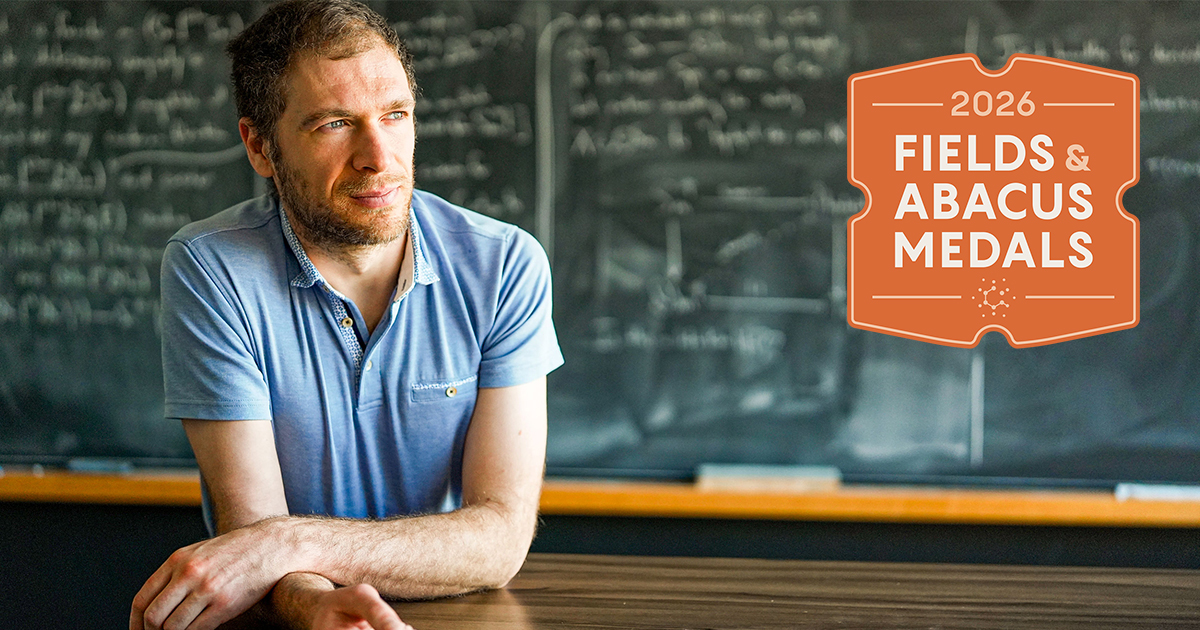
Several eminent mathematicians tell different versions of the same story about John Pardon.
Fifteen years ago, János Kollár was seated next to Pardon at a Phi Beta Kappa dinner. Kollár held an endowed chair as a full professor at Princeton University, where he’d been teaching for over a decade after stints at the University of Utah and at Harvard University as a member of its Society of Fellows, arguably the country’s most prestigious postdoctoral fellowship. Which is to say, Kollár is not bad at math. Pardon was an undergraduate, a few months into his senior year.
Kollár had gotten stuck on a question in the field of topology. At the dinner, he mentioned it to Pardon in passing. Two weeks later, he got an email from Pardon — with the solution. “And it’s not just that he solved the question I needed, but he did a much more general case in a very nice way,” Kollár recalled. He found working with the 21-year-old a pleasure. It felt, he said, “like working with a postdoc who had very good ideas.”
When Pardon graduated the following May, it was at the top of the Princeton class. In his valedictory address, he asked his fellow graduates, rhetorically, “When is the last time you had a truly original idea?” He proceeded to answer his own question: “The single most basic form of expression that humans draw upon is imitation of others, and so I think having an original idea may qualify you as being partially insane.”
By young Pardon’s definition, present-day Pardon, who turned 37 in June, is more than a little crazy, in that he has had not one but many original ideas. For these, the International Mathematical Union has now awarded him the Fields Medal, the most prestigious prize in math. “He started off solving well-known spectacular problems,” said Tobias Ekholm of Uppsala University. “At a slightly older age, he’s doing this same spectacular work, but he has this ability: He solves a famous problem but does it in a way that creates a framework, a whole new package, that will be useful to other people.”
Pardon, now at Stony Brook University in New York, is not particularly prolific. “His publication list is not very long,” said Kai Cieliebak of the University of Augsburg. “But every paper he wrote is some kind of breakthrough paper. All of them appeared in very top high-level journals.” Furthermore, Cieliebak said, Pardon “has done work in really a whole number of, to my understanding, completely separate areas of math. Probably somewhere in his brain these things might be connected.” As his former student Mohan Swaminathan, now at the Tata Institute of Fundamental Research, put it, “If John has a problem, he goes really deep and learns whatever is necessary for it.”
Pardon is tall and quiet. He has a gentle, unassuming affect and a reputation for kindness. He’s likely to be the best mathematician in any room he walks into, but he wears this lightly. He’s helpful to colleagues, sporadically answering graduate students’ questions on the online bulletin board MathOverflow. He sometimes weighs in on other subjects as well, with an invariable polite decisiveness. When one user, exasperated by their inability to make restaurant-quality pancakes, asked for help, Pardon offered advice: “The difference between ‘fluffy and fall-apart crumbly’ and ‘thinner, chewy, and sort of dense,’” he wrote, “is precisely governed by baking powder/soda. … If you want thin and chewy, omit the baking powder.” Pardon is as likely to ask for help as he is to offer it — airline ticketing, Schengen visas, and Wi-Fi passwords are as frustrating and confusing to him as they are to anybody. He is a father of two sons. He plays the cello well and learned to speak Chinese fluently in college, eventually winning a Chinese-language debate tournament held in Singapore.
Pardon declined to speak on the record for this profile. Many people who know him remark on his reluctance to say just about anything, least of all about himself. “He will only say something when he feels it is definitely correct,” said Shaoyun Bai, a mathematician at the Massachusetts Institute of Technology who got his doctorate under Pardon.
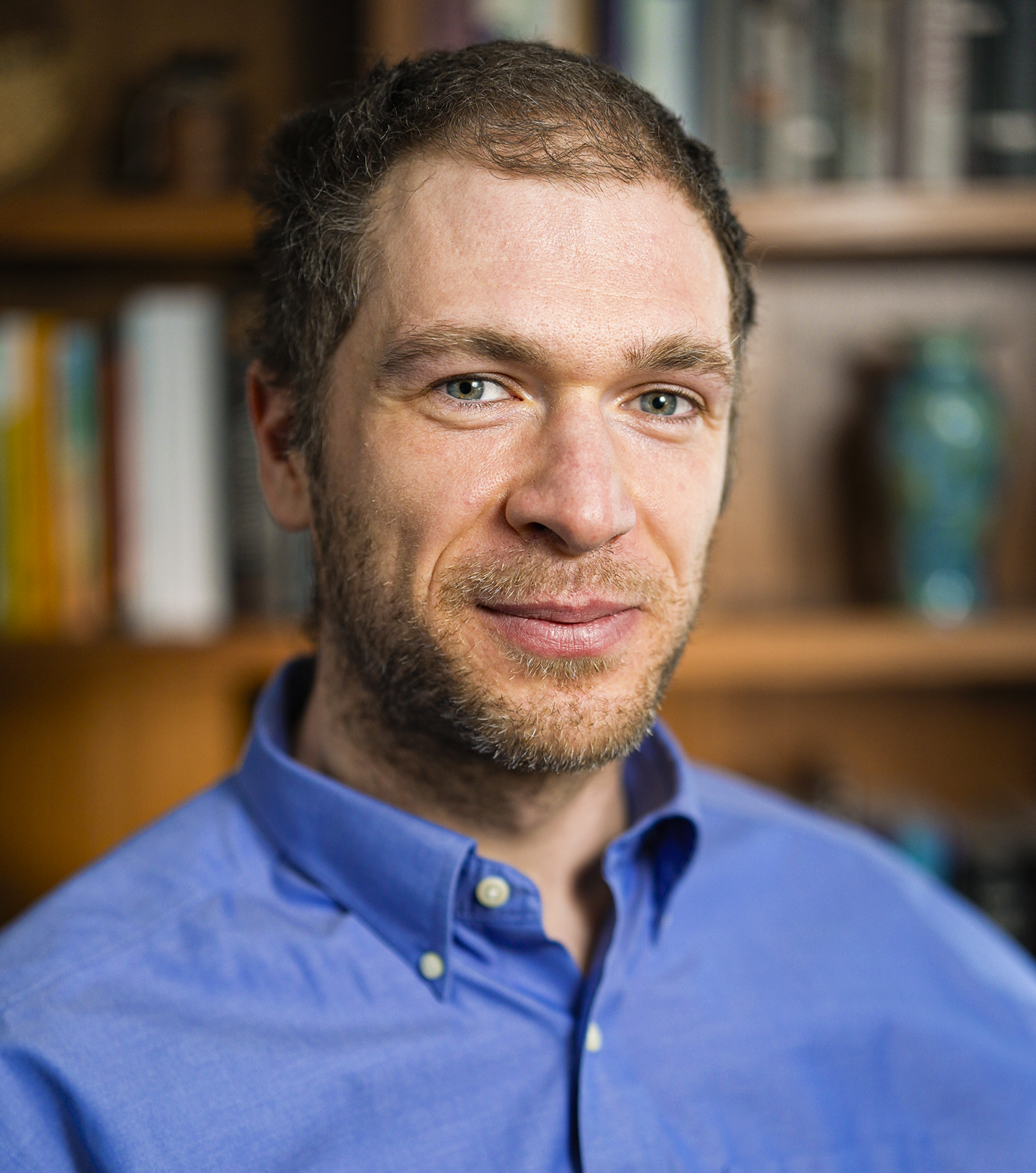
Pardon, though not particularly prolific, has proved major theorems in many different areas of math.
Phil Yam
“He refrains from saying too much,” said Thomas Massoni of Stanford University, another former student. “He knows so much that you really have to go fishing for his knowledge.” Multiple students recounted meetings with him where they had to do almost all the talking — but he was always available, glad to meet with them, and a patient listener. As Barış Kartal, who worked with Pardon while doing a postdoctoral fellowship, said, “He is silent, but he says very useful things.”
“I think John knows who he is and probably doesn’t want to come across as a cartoon of ‘Here’s a boy genius who’s done such-and-such a thing,’” said David Gabai, a former chairman of the Princeton math department. This is a real, reasonable concern. Nonetheless, when mathematicians speak about him, it’s hard to avoid the conclusion that he is a once-in-a-generation mathematical talent.
Like a generational talent in sports — Ohtani, Jordan, Messi — Pardon appears to be playing a different game than his colleagues, all of whom are themselves exceptionally skilled. But his achievements aren’t as easy to appreciate as a star athlete’s. Without years of study, it’s tough to understand just how surprising Pardon’s proof of a conjecture about six-dimensional manifolds really is. An earlier Fields Medal had been awarded in part just for making the conjecture.
So, with every intention of avoiding caricature, here’s a glimpse of Pardon’s work in knot theory, topology, and symplectic geometry.
Knot a Problem
Pardon was already the star of Princeton’s math department when he sat next to Kollár at that dinner during his senior year. He’d grown up in North Carolina, and by the time he was in high school, he was taking math courses at Duke University, where his father was a math professor.
Once in college, he set out to solve an open problem in knot theory that he’d first encountered in high school. As he later told his Stony Brook colleague Simon Donaldson, now at Imperial College London, he had more or less given up on it by the end of his junior year. But a line of attack occurred to him while he was walking in an English park that summer. A few months later, he had his proof.
Knot theory is one of those areas of math that are just what they sound like, but also somehow far deeper and more complicated than they seem. It is the study of knots — literally, given a length of rope, how can you tie it? (Mathematicians often splice the ends of the rope together.) But this question generalizes to higher dimensions and differently structured spaces, and in the end, the structure of knots is a powerful tool for understanding the geometry and topology of the spaces in which they can be embedded.
In 1983, the prominent mathematician Mikhael Gromov made a conjecture about a property of knots called the distortion. Consider two points on a knot. You can measure the distance between them in two different ways. Either you can travel along the rope itself, as though you were a tiny ant, or you can take a straight-line shortcut across space, as a (small) crow flies. It’s easy to intuit that the length you travel along the rope will always be at least as long as the straight-line distance. For any given knot, there will be a pair of points for which the ratio between the distance along the rope and the straight-line distance is the biggest. That ratio is the knot’s distortion.