Amid Life’s Chaos, a Meticulous Mathematician Finds Stability
Before he won a Fields Medal for his pioneering work balancing randomness and order, Yu Deng had to achieve equilibrium in his own life.

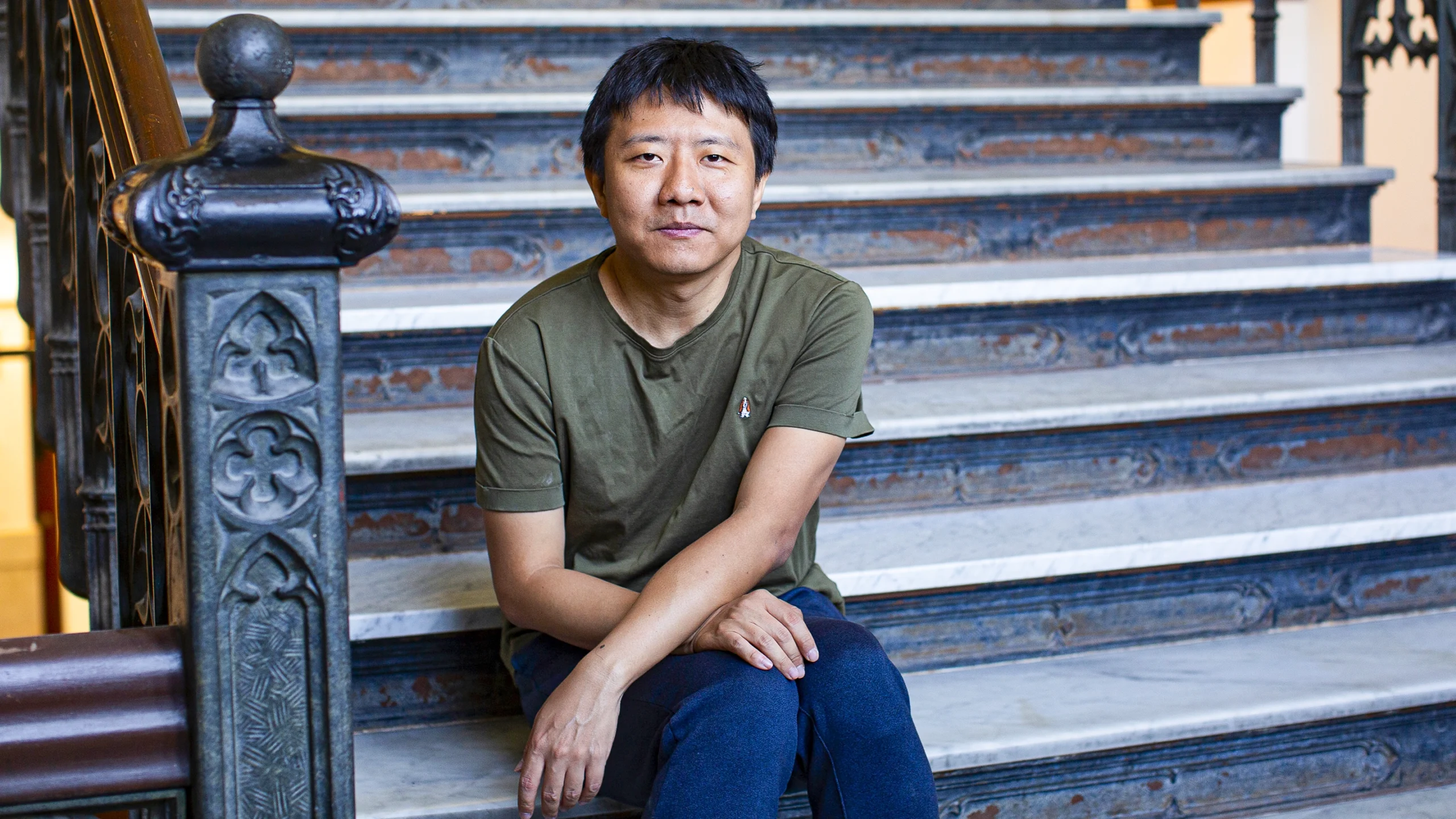
Yu Deng faced waves of uncertainty and doubt before attempting the work that would earn him a Fields Medal.
Kristen Normand for Quanta Magazine
Freedom and restraint seem like opposing forces, but to Yu Deng, they go hand in hand.
Take the poem he’s just pulled up on his computer screen: a dense forest of Chinese characters corralled into eight lines of equal length — a perfect, symmetric block of text. Written in the ninth century by the Tang Dynasty poet Li Shangyin, as China teetered on the brink of civil war, “The Brocade Zither” is famous for its ambiguity. “Many people have tried to explain it,” Deng said. “But I think this is something that’s not explainable.” A single word might allude to an ancient battle or a classic fairy tale; a simple phrase might have scores of diverging interpretations.
“My personal favorite of all time,” Deng said — an example of a highly structured form of Chinese poetry that literally translates to “regulated verse.” It must satisfy all sorts of rules: parallel constructions and contrasting images, lilting tonal patterns and strict rhyme schemes. “These patterns are part of the beauty,” Deng said. “But they’re also something that restricts your expression. The fact that you can still say so many things under this restriction is another level of beauty.”
Deng, a mathematician at the University of Chicago, explores the many things you can say under a mathematical form of regulated verse. He studies equations that describe how complicated systems of waves and particles interact. Like the Tang poet packing layers of meaning into a handful of couplets, “You are going to summarize, to compress, this whole big system in terms of this single equation,” he said. The solutions to these equations have a “very rich, natural structure,” full of hidden symmetries and “so many amazing coincidences, so many interpretations.”
Deng, who turned 37 in June, has now been awarded the Fields Medal, math’s highest honor, for pushing the study of these equations — and the physical systems they model — past what anyone thought possible. He and his colleagues have proved major theorems, some in papers more than 100 pages long, on how randomness moves through systems, and on how larger-scale behaviors emerge from those interactions over time.
“People thought this was, I don’t know, a decade in the future,” said Benoît Pausader, a mathematician at Brown University and one of Deng’s collaborators.
At its core, the work is about bringing the flexible nature of probability into the rigid, structured world of wave equations. Freedom and restraint. Hand in hand.
Go Pro
In a parallel universe, Deng became not a mathematician, but a professional Go player. It was the nearest of misses that set him on his current path.
Shortly after he was born in 1989, his family moved to Shenzhen, China, at a time when the city — a cluster of fishing villages just 10 years earlier — was growing rapidly. (Today it’s the country’s third-largest metropolis, home to more than 18 million people and one of the world’s biggest tech hubs.) When Deng was young, Shenzhen’s Shekou Industrial Zone, where he grew up, was “a really underdeveloped region” where “you’d see all this waste on the street. It had a terrible smell.” But within a few years, he said, the district had clean streets, subways, parks, and luxury apartments. Billboards and posters loudly declared the city’s slogan: TIME IS MONEY! EFFICIENCY IS LIFE!
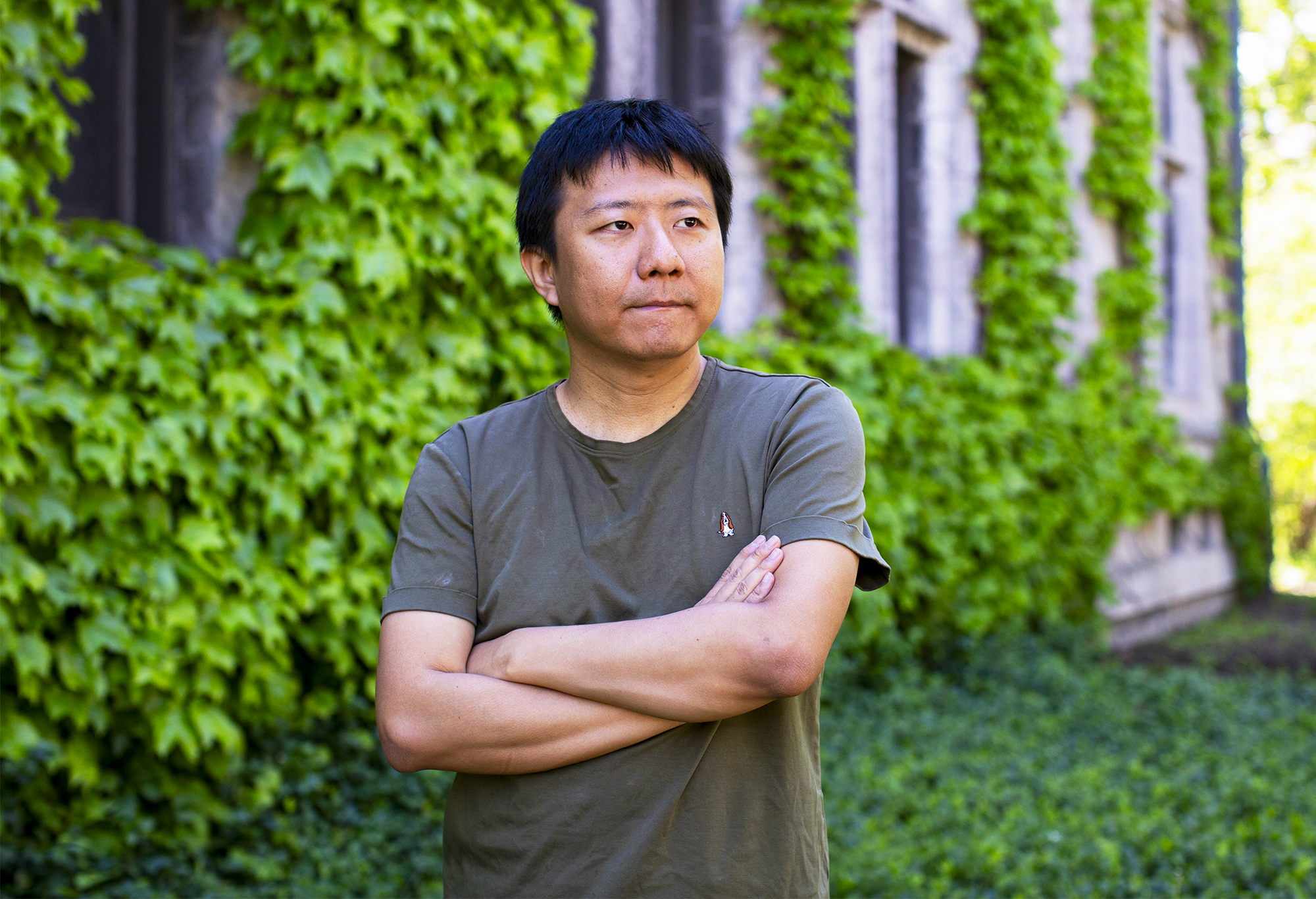
Deng’s path to math took him through the world of competitive Go.
Kristen Normand for Quanta Magazine
Deng was a quiet, contemplative child. He preferred to spend long hours alone, reading whatever he could get his hands on. His mother, a gastroenterologist, said that by the time he was 5 or 6, he’d read some of her medical textbooks, frequently asking questions about anatomy and structure. “Given how young he was, all of my colleagues thought it was quite amusing,” she said in Mandarin.
Soon enough, he had “basically read all the books in our study,” she recalled. To get him outside more, she and her husband, a software engineer, took him on hikes or walks along the beach, with the promise that he could read or visit a bookstore as soon as they finished. If he misbehaved, “the most effective punishment was to forbid him from reading,” his mother said.
On some of those hikes, his father gave him math problems to solve. He still remembers one: You have a square grid divided into a certain number of cells. Prove that if you remove any one cell from the grid — it doesn’t matter which — you can always perfectly divide the rest of the grid into L-shaped pieces made from three cells each. The solution, which Deng figured out, required a concept known as induction, usually taught in high school. Deng was 7 years old.
His parents grew concerned that Deng’s constant reading would ruin his eyesight, so they bought him a Go set. He took to the game immediately. It wasn’t long before he was spending almost all his free time exploring the universes he could create with the black and white stones — solving puzzles, finding optimal strategies, getting lost in thought for hours on end.
“Playing Go was something that allows you to focus on a single thing for some time, usually two or three hours,” he said. “I enjoyed that.”
He got good quickly, playing at a local Go club and competing in district and city-wide tournaments. “He had this unwillingness to admit defeat,” his mother said. “When he played Go with his friends, if he lost, he would insist on playing again and again until he won.”
In 2001, when he was in middle school, he competed in the national pro qualification tournament, a grueling competition to enter the world of professional Go. By the final three games of the tournament, he needed only one more win to qualify. He lost all three. He tried again the following year, but his heart was no longer in it.
Ever since those early family hikes, Deng had also been nurturing a passion for math, for the same reasons he’d been drawn to Go: He could spend long periods alone with a single problem, looking for patterns and trying to find the unique path to the right answer. And he was good at it. “But it wasn’t serious” then, he said.
After his loss at that Go tournament, though, his assessment was almost clinical: “There was a choice,” he said. “Either Go or math. Since I lost, I decided to move my focus to math.”
He set a goal: to compete in the International Mathematical Olympiad (IMO), the most prestigious math competition for pre-college students in the world. His math teacher at the time was also one of China’s best Olympiad coaches, and they started to train together on evenings and weekends. In his last year of middle school (the equivalent of ninth grade), he’d learned the entire high school math curriculum, but he failed to pass the first selection round to compete in the IMO.
“Then I felt really bad,” Deng said. So he worked harder. The next year, he made it through three selection rounds and earned a spot on the national training team. But he wasn’t one of the six students ultimately selected to represent China.
His focus and ambition never flagged. “I really wanted to win,” he said. The following year he did more than make the team; he won a gold medal.

Deng in his office at the University of Chicago, where he’s been a professor since 2025.
Kristen Normand for Quanta Magazine
His performance earned him automatic admission to Peking University, one of China’s top colleges. At first, “I didn’t even think about choosing math as a career,” he said. “I kind of gradually realized that this is a good thing for me.”
The Olympiad experience “made me think, maybe this is something I really have talent for.” So, he figured, “why don’t I just do it?”
New Perspectives
After two years as a math major at Peking University, he transferred to the Massachusetts Institute of Technology. It was common for Chinese math students to attend graduate school abroad, but rare for undergraduates. “You are going to go somewhere outside of China eventually,” Deng said — so why wait?
That first year he attended a talk that would set the course of his career. Andrea Nahmod — a mathematician visiting from the University of Massachusetts, Amherst, who would later become one of Deng’s closest collaborators — presented research on the so-called random data problem. Deng was hooked.
The random data problem asks about the solutions to certain kinds of partial differential equations, or PDEs, that describe how complex wave patterns — from water waves in the ocean to light waves in fiber-optic cables — change over time.
In particular, Nahmod wanted to show that, no matter how your waves look at the beginning, the PDE can accurately model what will happen to them at any point in the future. There might be cases where the equation breaks down and fails to describe what a wave will do next, but such cases should be extremely rare. If you start with some random wave pattern, the PDE should have a solution that describes its behavior at later times.
The problem is that for most PDEs, the existence of this solution is exceedingly hard to prove.
“I found this idea very interesting,” Deng said. Because the question involves a random starting point, it brings probability theory — used to define that starting point and to prove statements about what happens next — into the deterministic world of PDEs. “You are seeing your equation from a completely different point of view.”
After the talk, Deng asked Gigliola Staffilani, a mathematician at MIT who was acting as his informal adviser, to give him a related problem to work on over the summer. She found him one, on the behavior of solutions to a two-dimensional version of the nonlinear Schrödinger equation, a famous PDE that describes how waves move and interact.
When Deng returned in the fall, he had a completed paper in hand. Staffilani was taken aback by how sophisticated it was. “I was like, ‘Oh my God, this kid, he’s really spectacular,’” she said. “I had not seen any work like that, not even from my graduate students, at least not polished in that way. It was done.”
The paper was published in the journal Analysis & Partial Differential Equations. “I was excited about that,” Deng said. “And I was thinking, one day I could publish in an even better, top journal.”
He’d heard about a student his age named John Pardon — another Fields Medal recipient this year — who published a paper in the Annals of Mathematics, the field’s top journal, as an undergraduate. Was he envious? “A little bit,” Deng laughed.
Uneasy Tidings
Deng often gets his best ideas when he’s alone in open spaces — on hikes, near the ocean. He finds a similar feeling in the Tang poetry he’s drawn to. “It’s a lonely kind of atmosphere,” he said of one line. Of another, “I like the view. By yourself, hearing these sounds, looking at the sky, seeing the sky reflected in the river … Everything is by yourself. You stand there and think.” The stars are distant, he said, even your thoughts are distant, as you contemplate historical events from long ago; you are completely, utterly alone, the world quiet around you. “It’s really a nice feeling.”
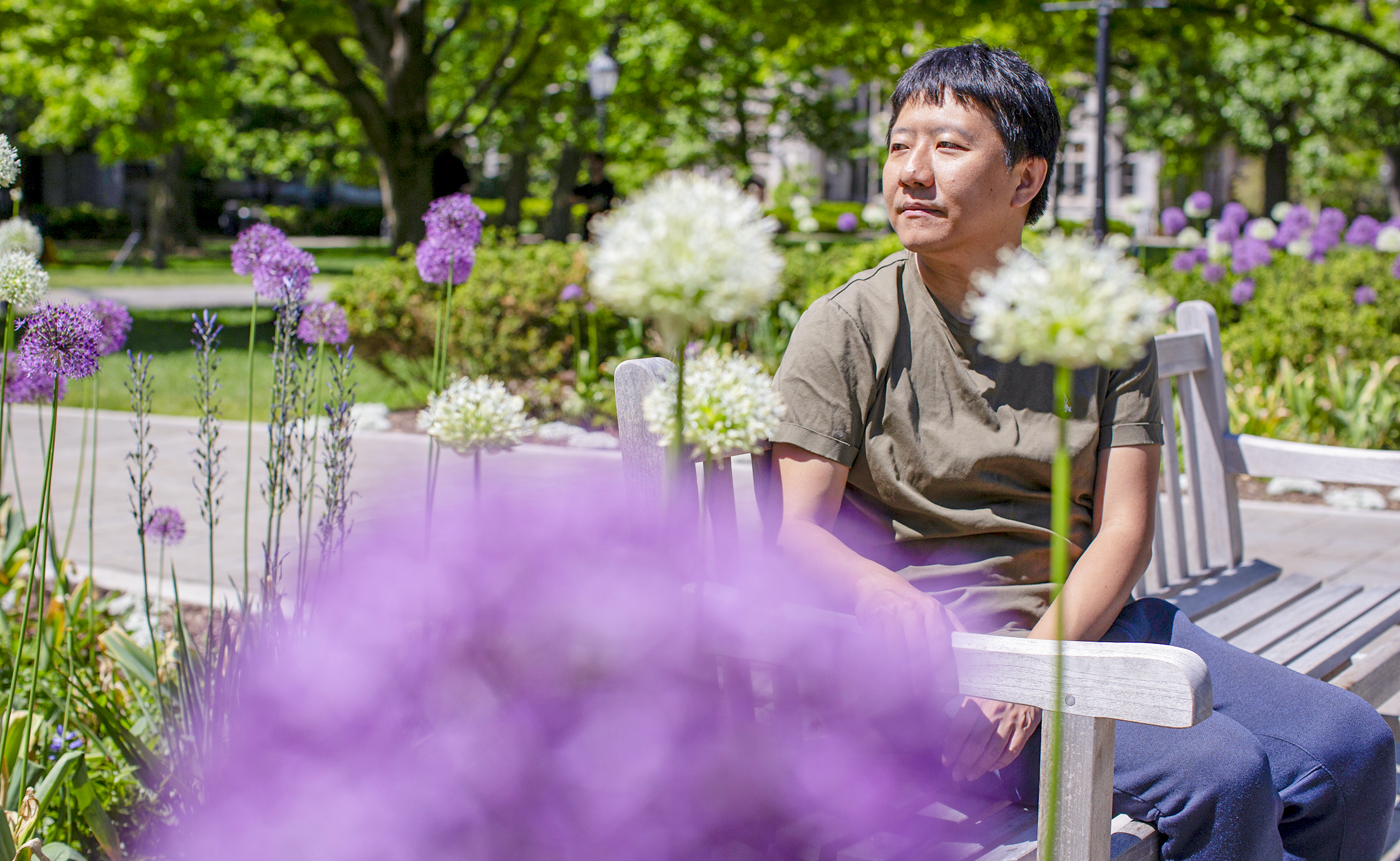
Deng has turned to nature during times of stress and uncertainty.
Kristen Normand for Quanta Magazine
He lingers over such forlorn, isolated scenes when he writes his own poetry, too.
His living room is pretty much empty. There’s a desk, a whiteboard, a small bookshelf, and an armchair. No couch, no TV, no art on the walls, no rug on the floor. “It’s good for me,” he said. “It’s a feeling of freedom. I can just walk around and think.” Even though he’s lived there for a year and a half, it looks like he just moved in. His biggest adjustment in his undergraduate years, he said, was living with roommates.
Even when he’s around the people he’s closest to, Deng is humble and reserved. He’s eager to discuss math — when he does, he talks a bit faster, a bit louder — but according to his colleagues, when the conversation moves to other topics, his responses are short and pointed. He doesn’t see the need to elaborate or steer the discussion in new directions. (When asked if he has any favorite poets: “Yes.”)
Deng doesn’t drive — never even got a license — because he fears that his mind will drift to math while he’s on the road. As an undergraduate, he once went line-by-line through a highly technical PDE paper, all 75 pages. It took him a week, eight hours per day. “I just checked every single detail,” he said.
While he no longer has quite that level of stamina, he’s still able to devote long hours to reading a paper thoroughly, or to working on a problem. “If I don’t make good progress, I will be really disappointed, and I will keep thinking about it,” he said.
He finished his degree at MIT in 2011, then went to graduate school at Princeton University, followed by a postdoc at the Courant Institute at New York University. “He was brilliant from the beginning,” said Alexandru Ionescu, Deng’s doctoral adviser. “Even as a graduate student, without experience … he was very good at getting at the essence of the thing, picking up what matters in a problem.”
Deng wanted to make progress on the random data problem, specifically when PDEs start with “rough” initial waves — random waves that oscillate wildly or have discontinuities. If he could show that even under these conditions, a PDE must have a solution, he’d have a deeper understanding of the equation and of a particular property of physical systems called the Gibbs measure.
But he soon realized that the tools available at the time weren’t up to the task. “We could get some results, but they were not satisfactory,” he said. He moved on to other questions, but they didn’t grip him in the same way. He began to feel aimless and, at times, “a bit depressed.”
“The work I did at that time wasn’t the best,” he said.
“I think it hurt him,” said Nahmod, who would later become a close confidante and friend. “He’s very sensitive.”
For comfort, Deng turned to manga. “I remember him at Courant. He was always holding a manga,” said Jalal Shatah, a professor there who formerly chaired the math department. Deng particularly liked stories about deep friendship and romance and found himself drawn to a genre known as yuri, which focuses on those kinds of relationships between women — stories that “feel nice and warm and beautiful,” as he put it. They helped him be kinder to himself, “more comfortable with life.”
In 2017, as the end of his NYU postdoc drew near, Deng hadn’t gotten tenure-track offers from his preferred institutions. For several months he considered going back to China or taking a job in finance with one of the companies that had been recruiting him. “I told them I still want to do math, but if I realize I cannot reach what I’m aiming for, then maybe I could consider this,” he said.
Deng still liked being alone — preferred it, in fact — but for the first time, he felt lonely.
He envisioned the days and years ahead. “In the end, as a mathematician, I’m just going to do math every day,” he said. “Go to school, go home, go to school, go home.” But he felt overwhelming uncertainty about that future. Would he be able to produce great results? Would he get recognized for them?
He recalled reading a manga, “one of these idealized stories where people get together, and they work, and they have these complicated lives. Eventually, they lead a good life. So I was reading this, and suddenly I got pretty emotional. I was thinking, ‘OK, then what about myself?’”
That winter, feeling “very stressed and anxious,” he took a train to nearby Long Beach, on the south shore of Long Island, where he booked a hotel room. There, he roamed the coastline and wrote poetry, pouring himself onto the page in eight lines of restricted verse, the same style that Li Shangyin had used. He wrote about how he wanted to escape. How doing so would be a betrayal of his dream to do math. How the tides seemed anxious, unsettled.
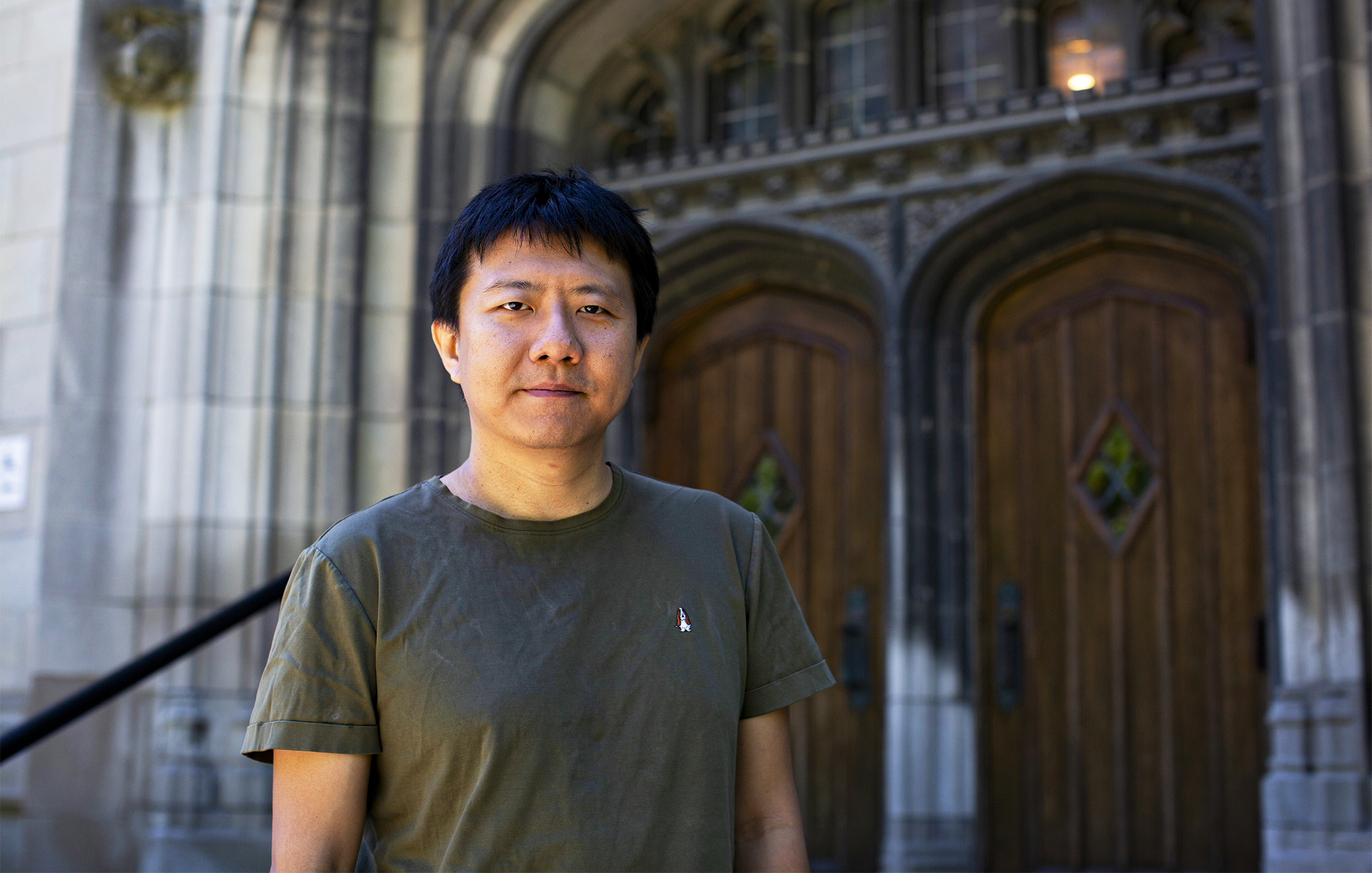
Deng’s focus on math is so absolute that he doesn’t drive, as he worries his mind will drift to math when he’s on the road.
Kristen Normand for Quanta Magazine
Once he’d gotten it all down, “then I could say, ‘OK, this is done.’ I could go back to my life,” he said. He returned to Manhattan. He remained uneasy, but after a week without work, he “automatically felt a need to work, to do math.”
He kept grinding, and tried to push the doubts out of his mind. Then, in 2018, he got a tenure-track offer from the University of Southern California. He accepted.
Rediscovered Path
Another mathematician who was feeling lost drew Deng out of this period of anxiety — and back to the random data problem. Haitian Yue had just started his postdoctoral research at USC and was having a hard time. “I didn’t find a really good project. I didn’t have a goal,” Yue said. While driving Deng back to his apartment after a group dinner — everyone knew Deng didn’t drive, even in Los Angeles — Yue confided his worries and mentioned that he’d done his doctoral work on the random data problem.
Deng thought it was a good time to return to it and suggested that they collaborate with Nahmod, whose talk had first drawn Deng to the subject.
Deng, Nahmod, and Yue turned to the two-dimensional Schrödinger equation, and set out to show that even when you start with a random initial wave that’s particularly rough, the equation still has a well-defined solution. If they could prove this, they’d then be able to show that the equation has a hidden statistical structure.
Say you randomly choose an initial wave from infinitely many possibilities, according to a well-known rule called the Gibbs measure. That rule, which is supposed to model a system in a state of equilibrium, says that some fraction of possible initial waves has one property, and some fraction has another, and so on. Any particular wave might change over time and end up exhibiting very different properties. But Deng, Nahmod, and Yue wanted to show that if you look at all the waves you end up with, they are still distributed according to the same rule that you started with. That, as mathematicians put it, the Gibbs measure is “invariant.”
Traditionally, mathematicians would approach the problem by splitting the solution to the PDE into two pieces and analyzing them separately. But that didn’t work in this case: One of the pieces was still too complicated. So Deng, Nahmod, and Yue split up that troublesome piece even further. They then developed tools called random tensors to analyze the pieces and explore how they influenced one another.
Yue recalled that when they met in person to work on the project, Deng would often go quiet, lost in thought for five, 10, 15 minutes at a time. “Andrea and I would keep discussing, while Yu Deng kept silent and tried to think by himself,” Yue said. “In his mind he does a lot of computations. Then suddenly he’d erase what we wrote down and say, ‘We should do it like this.’”
“It was just magical,” Nahmod said. “Collaborating with him is exhilarating. When he is interested in something, he focuses like a laser beam.”
As Pierre Germain, his postdoctoral adviser, put it, “When you work with him, it’s like you are running after a train.”
This skill ultimately allowed the trio to understand the solution to the two-dimensional Schrödinger equation, and to prove that the Gibbs measure is invariant. The proof was later published in the Annals, fulfilling the goal Deng had set for himself years before.
A Secret Project
Around the same time that Deng started to work with Nahmod and Yue, he met Zaher Hani — an encounter he credits with also helping to dispel his period of doubt and depression.
Hani, a mathematician at the University of Michigan, was also studying solutions to PDEs with random initial waves, but with a different goal in mind. Take the Schrödinger equation, which reveals how individual waves will interact and influence each other over time. Physicists have long accepted that from this “microscopic” description of a system, it’s possible to derive a higher-level description of the system’s average behavior, which is given by a different equation — the so-called wave kinetic equation.
Mathematicians like Hani hoped to offer a rigorous proof of that derivation.
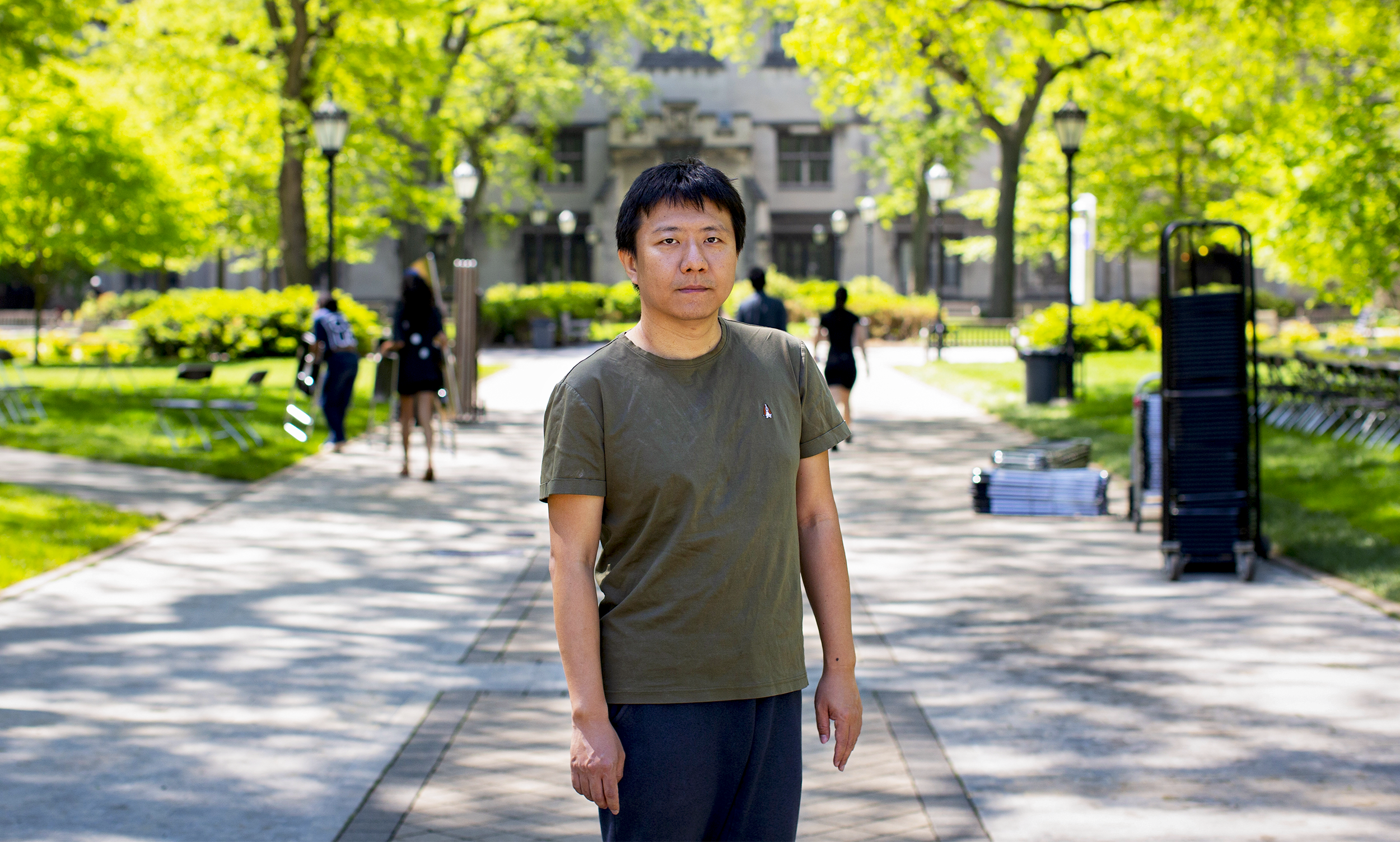
Deng’s attention to detail is legendary. “He knew everything, 200 pages of computations, off the top of his head,” said a colleague.
Kristen Normand for Quanta Magazine
In 2019, Hani and some colleagues had just proved that the Schrödinger equation converges to the wave kinetic equation on short time scales. But on longer time scales, waves have the chance to interact in far more complicated ways that seemed impossible to deal with. Hani realized that insights from research on the random data problem might help. “At that time, I had already asked several other experts in the field. And I didn’t get any satisfactory answer,” he said. “Until I asked Yu Deng. He had precisely the right idea that I needed.”
The two teamed up and extended Hani’s previous result to a time scale just shy of what physicists cared about. Deng was ready to stop there. “I was worried that it might not be doable, that the tools weren’t enough,” he said.
But Hani persuaded him to keep going. They ended up abandoning previous approaches and developing their own technique “from scratch,” Germain said. “It’s completely crazy … It’s nice, or scary, or however you want to put it, that they ignored everything and just went vroom.”
First they represented the longer-term solution to the Schrödinger equation as a complicated sum of diagrams that resembled trees. To prove that this sum converged to the wave kinetic equation, they needed to estimate how much each tree contributed to the sum.
“These estimates were beyond anyone’s ability,” Shatah said.
As Ionescu put it, “it requires a very strong mind to do it.”
Deng has the right kind of mind. For one, he’s very good at combinatorics, a skill that his colleagues say sets him apart. And “he’s fearless,” Hani said. “I mean, sometimes there are computations that might take me half a day to psych myself up to do them, and then take me the other half of the day in order to do them. He can do them in an hour or two.”
The duo showed that some of the trees cancel each other out, contributing nothing to the overall sum. They then found a clever way to cut the remaining trees up into smaller pieces that were easier to analyze. It required what Hani described as almost surgical precision.
“My mind was exploding,” Deng said.
By working with these smaller pieces, they proved that, indeed, the Schrödinger equation gives rise to the wave kinetic equation over the right time scales — a result that they later extended to even longer (and more realistic) time scales.
That last proof, he and Hani realized, might hold the key to another problem — one that was so ambitious, and that so many other researchers were already trying to solve, that they felt they had to work on it in secret.
At the turn of the 20th century, the mathematician David Hilbert asked a question, his so-called “sixth problem,” about bridging microscopic and macroscopic descriptions of gases. It was essentially the same problem that Deng and Hani had just solved for waves, but for particles in specific settings.
These problems only seem the same “if you look at things from afar,” said Isabelle Gallagher, a mathematician at Paris Cité University who had spent years working on Hilbert’s sixth problem. “They’re physically very different.”
Deng and Hani set their sights on the problem anyway, which had been resolved on shorter time scales only. Joined by Xiao Ma of the University of Michigan, they worked day and night, analyzing new diagrams and figuring out how to cut them up in even more complicated ways. They came close to burnout.
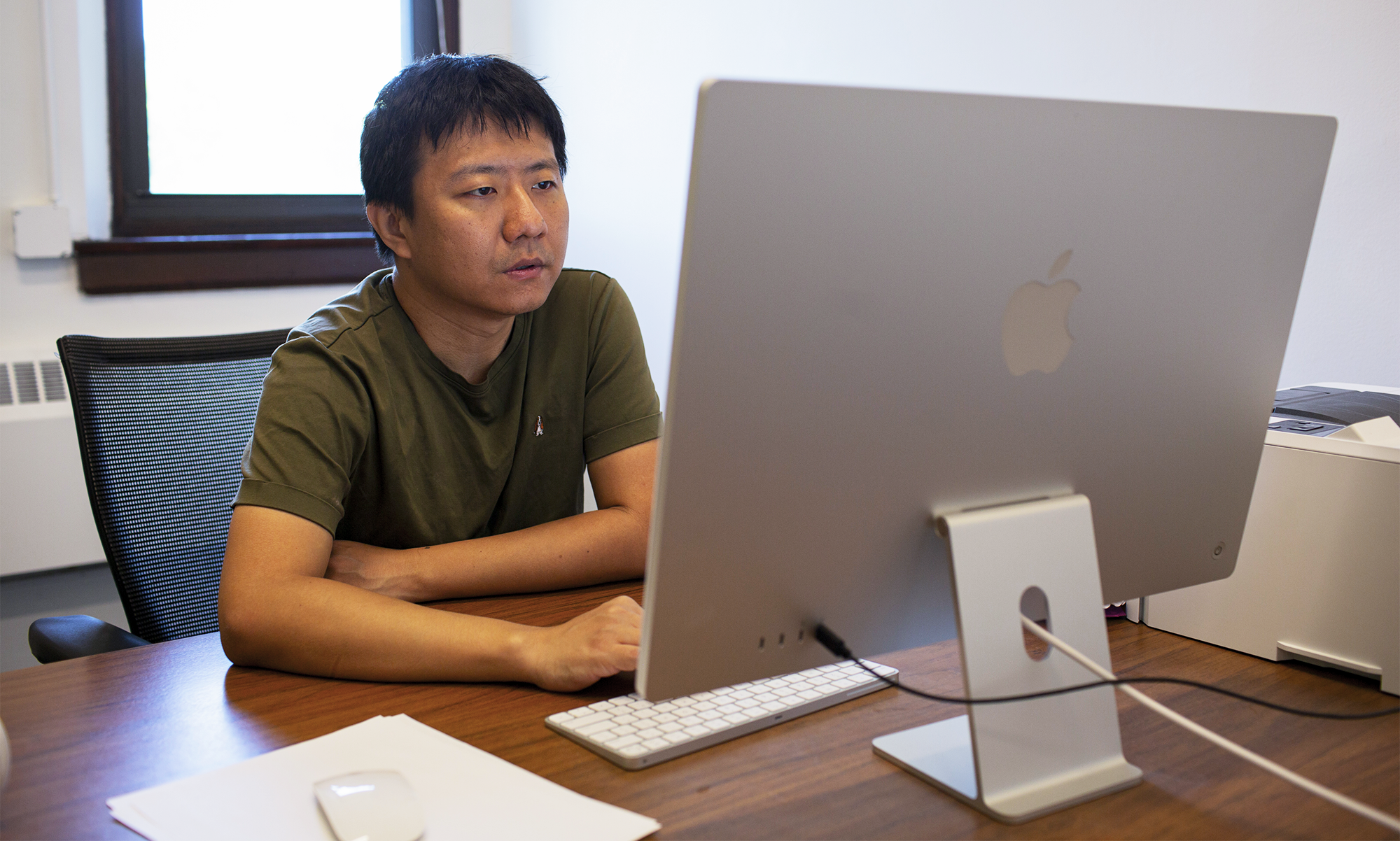
Deng’s office, like his home, is austere.
Kristen Normand for Quanta Magazine
Deng recalled chugging energy drinks and barely going outside as he worked out the final details. He was visiting his parents in China at the time. They’d be eating or talking, his mother said, when “suddenly a math problem would flash into his mind. We’d know at that moment we should stop talking, as he had already entered his own mathematical world.”
By August 2024, Deng, Hani, and Ma had finished their 200-page papersolving Hilbert’s 124-year-old problem for long time scales. It took months for the rest of the mathematical community to even start to digest it. “We were so lost and confused,” Gallagher said. Deng flew out to Paris to walk her and her colleagues through the work. “He really wanted us to understand,” she said. “He was incredible. During the whole week, I don’t think he took out his notes one single time. He knew everything, 200 pages of computations, off the top of his head.”
Deng, Hani, and Ma later rewrote their paper to make it more readable. This revised version is now set to appear in the Annals, too.
Something New
Deng still holds himself to extremely high standards. When he found out he’d won the Fields Medal in January 2026, he felt more relieved than excited. He hadn’t really cared about winning the award, but as rumors started to spread that he was on the short list, “I was a bit stressed,” he said.
Now he no longer worries so much about his future. He’s doing work he cares about; he’s widely recognized for it. And he sees beauty in the questions he’s exploring. That beauty might not be obvious: There’s an ad hoc, brute-force aspect to it. Each time he analyzes a different set of equations, he has to redo all the details, even if the overall approach stays the same.
“But each time,” Deng said, “we have something new, which is also interesting.”
There’s also something satisfying about the way combinatorics ended up playing such a massive role in his work. It echoes his childhood — spent on Go, one of the world’s most combinatorially rich games, and mathematical Olympiads, which tend to be highly focused on combinatorics. It echoes what first drew him to poetry, too: the seemingly endless proliferation of meanings made possible by a simple combination of words. His research has in that way become familiar, a place where he can feel at home.
His life now looks much the same as it has for the past decade. But he’s comfortable. According to Nahmod, although Deng is still quiet, he’s no longer painfully shy. He reads and writes poetry. He plays Go from time to time. He’s thinking of getting a pet snake because “it looks good. It’s beautiful,” he said. He reads manga, but purely for enjoyment, not because he’s trying to be less hard on himself.
“I have less pressure,” he said. Which means that “you can just think about math, as you want.”
“We’ll see how much I can get to.”

