OPINION
For 50 years, the Endangered Species Act has defined “harm” as not just injury to individuals but to the habitat on which they depend. By narrowing that definition, the Trump administration is leaving hundreds of species at risk of extinction.
By hatching a new definition of the word “harm,” the Trump administration has effectively killed the Endangered Species Act (ESA).
For 50 years, the legal definition of “harm” has included the destruction of habitat that sustains threatened and endangered species. But a new rule, finalized July 14, redefines harm as only physical damage to individuals. So, provided individuals of a listed species are not directly injured or killed by humans, it’s perfectly okay to destroy all habitat required for their survival, thereby rendering them extinct. “Common sense” is how Interior Secretary Doug Burgum describes it.
Wildlife advocacy groups are outraged, saying the rule change “violates the core purpose of the statute and decades of legal precedent” and is “a stake through the heart of the ESA.” Multiple lawsuits to block the rule are underway. Unless they succeed, the new harm rule will go into effect on September 14.
Under its 50-year-old definition of “harm,” the ESA has prevented 99 percent of listed species from going extinct. That’s because federal agencies were legally mandated to protect and restore critical habitat. They didn’t have a choice. If the new harm rule stands, no such mandate will exist.
Under the new definition of harm, it will be legal for developers to build houses and malls on black-footed ferret habitat.
Among the horrific damage to wildlife will be the extinction of arguably America’s most endangered mammal, the black-footed ferret. The salvation of the species, presumed extinct before its rediscovery in 1981, has been one of the ESA’s great success stories.
In 1986, just 18 black-footed ferrets remained on the planet, six of which were kept at the Wyoming Game and Fish Department’s Sybille wildlife research facility. Black-footed ferrets are susceptible to human diseases, so when I visited the facility in March of that year, state veterinarian Tom Thorne and I rinsed our feet in antiseptic solution, showered, climbed into blue jumpsuits, and put on rubber sandals and plastic shower caps.
Thorne led me into the ferret room. In a wood-and-wire cage, a young male checked us out, then dove into a drainpipe. I hadn’t expected black-footed ferrets to be so small or so beautiful. “Watch now,” said Thorne. “He’ll pop his head back out and look at us.” He did.
The drainpipe simulated a prairie-dog burrow. Black-footed ferrets prey almost exclusively on prairie dogs and depend on their burrows for shelter — no prairie dogs, no black-footed ferrets. Mandated by the ESA, federal wildlife managers and partners protected and restored prairie-dog towns in some of the best potential ferret habitat across the West. Today there are an estimated 500 black-footed ferrets in the wild, while about 280 others are being held in captive breeding facilities.

A black-footed ferret that was reintroduced near Meeteetse, Wyoming.Alex Milan Tracy / Sipa via AP Images
Under the new definition of harm, it will be legal for ranchers and county, state, and federal agencies to poison prairie dogs in black-footed ferret habitat and for developers to build houses and shopping malls on top of it. The species won’t have a chance.
The new harm rule is also a certain death sentence for the northern spotted owl, which depends on canopy-dense, multi-layered old-growth forest in the Pacific Northwest. The owl is listed as threatened, though an upgrade to endangered status is warranted, according to the U.S. Fish and Wildlife Service.
Logging fragments old-growth forests, destroying canopy travel corridors used by the owl’s prey, such as northern flying squirrels and red tree voles. The U.S. Fish and Wildlife Service has designated 9.4 million acres as critical habitat for the northern spotted owl. Under the traditional definition of harm, logging northern spotted owl habitat was illegal unless timber companies obtained special permits and submitted plans to mitigate the loss of spotted owls. With the rule change, all that habitat is open for business.
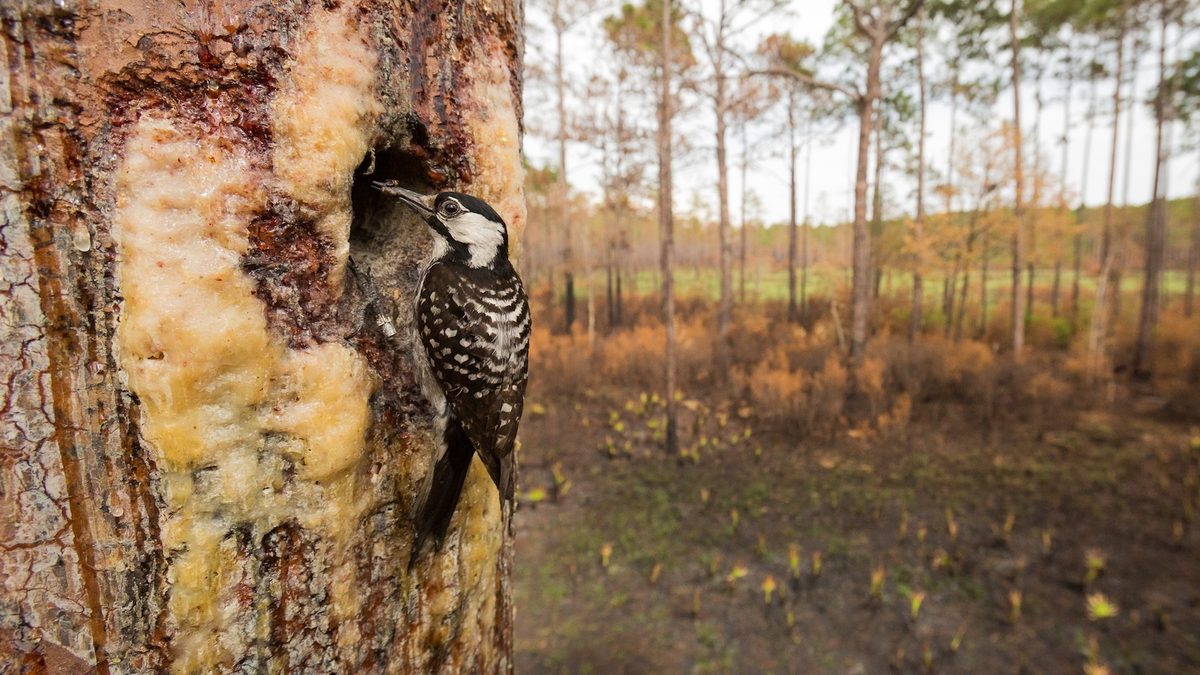
Before the Endangered Species Act, logging eradicated many of the longleaf pines that red-cockaded woodpeckers depend on.
Another spectacular ESA success story is the salvation of red-cockaded woodpeckers. Without the law, the species would now be extinct.
On a crisp day in October 1995, Jay Carter and Kerry Brust, researchers from North Carolina State University, led me to a tall longleaf pine in the Sandhills area of North Carolina. At twilight, an endangered red-cockaded woodpecker dipped from a high bough, emitted a “roosting chuckle” and entered a hole above a long, white sap stain. No other North American woodpecker excavates nest holes exclusively in living trees. The species depends on sticky pine sap to repel predators.
Brust pressed a long-handled net over the hole while Carter scratched the bark with a stick to imitate the sound of predator claws. The bird shot into the fine mesh, then shrieked as Brust folded his fingers around it. Carter replaced the red and blue leg bands that identified the bird.
Brust and Carter were part of a multi-agency partnership desperately trying to prevent impending red-cockaded woodpecker extinction. The work was not going well. The longleaf pines these birds need for nesting evolved with wildfire, which opens the cones so seeds can disperse. Historically, fires have also kept understory brush from reaching a height that would allow predators to climb to woodpecker nests. The prevention of wildfires did away with that protection.

A northern spotted owl in Shasta–Trinity National Forest in California.Polinova via Wikipedia

Well before there was an ESA, logging eradicated longleaf pines, while wildfire prevention prohibited their regeneration, destroying most of the woodpecker’s habitat. The original longleaf forest covered at least 92 million acres of the Southeastern United States, sustaining an estimated 3 million red-cockaded woodpeckers. By 1995, only about 3 million acres of longleaf forest survived, and the woodpecker population was down to fewer than 15,000 birds.
What’s more, the ESA was under attack by property-rights activists, represented and incited by Congressmen Don Young (R-Alaska) and Richard Pombo (R-Calif.), who sponsored legislation that would have legalized harm to habitat, just as the Trump administration has done. And, fearing that the ESA would prevent them from logging woodpecker habitat, landowners were clearcutting longleaf pines before their holdings could be surveyed for woodpeckers.
Enter Bruce Babbitt, President Clinton’s Interior Secretary, who saved the ESA with “Safe Harbor” agreements, by which landowners pledged to create new red-cockaded woodpecker habitat by administering prescribed burns to open cones and release seeds, pruning to keep understories low, allowing longleaf pines to mature, and installing artificial nest cavities in the trees. In return, the U.S. Fish and Wildlife Service allowed the landowners to harvest the longleaf pines on that new habitat, provided they gave the agency time to capture and relocate any nesting birds to other pine forests.
About 99 percent of public comments opposed the new rule redefining harm, an analysis found.
Saving the species from imminent extinction were 459 Safe Harbor agreements across 2.5 million acres. The red-cockaded woodpecker population increased by 430 percent from the late 1970s to 2024 — the year they were downlisted from endangered to threatened. Had the Trump administration’s redefinition of harm been in place, there would have been no ESA habitat mandate. And with no constraints on logging by landowners, and no motivation for them to create new habitat, Safe Harbor wouldn’t have worked.
Black-footed ferrets, northern spotted owls, and red-cockaded woodpeckers are just three of hundreds of ESA-listed species certain to be ushered into oblivion by the Trump administration’s nonsensical harm rule.
Supporters of the new harm rule note that it will not apply to land managed by the National Park Service. But many listed species on that land rely on habitat in adjacent buffer zones where the new rule will be in effect. For example, grizzly bears, Canada lynx, and wolverines in Yellowstone National Park all inhabit adjacent national forests in the Greater Yellowstone Ecosystem. And Florida panthers establish large territories extending far beyond the boundaries of Everglades National Park and Big Cypress National Preserve. Removing protection for all such non-park habitat would diminish populations within National Park Service land and lead to isolation and inbreeding.
What do Americans think about the new harm rule? The answer is evident in the almost 360,000 public comments filed with the Trump administration. While the administration declines to list the number or proportion of negative responses, an analysis by Earthjustice reveals that about 99 percent of the comments were opposed. Under the Administrative Procedure Act, federal agencies must consider public commentary and provide a rational, evidence-based explanation for their final rule. The Trump administration routinely ignores this directive.
Unless plaintiffs succeed in their lawsuit to block the administration’s redefinition of “harm,” the most successful fish and wildlife protection and recovery law ever enacted will essentially cease to exist.