Graduate Student Proves a Quantum Uncertainty Principle for Fractals
The math, which combines chaos, quantum theory, and infinitely complex fractal structures, has been called a “foundational result.”
Ada Zejun Shen/Quanta Magazine
Introduction
At the quantum scale, tiny particles behave in bizarre ways. One reason for this is the uncertainty principle, which says that the more you know about where a quantum particle is, the less you can know about how fast it’s moving, and vice versa. Recently, this rule got a rare upgrade.
The new uncertainty principle relates to fractals, shapes that remain equally complex no matter how much you zoom in on them.
Around a decade ago, Semyon Dyatlov, a mathematician at the Massachusetts Institute of Technology, was studying whether quantum particles behave differently than ordinary particles when put into the same chaotic situations. Sometimes, an object moving chaotically can become trapped into following a fractal-like path forever. Could quantum particles do the same?
Quantum particles tend to spread out like waves, which blurs their exact location. To figure out whether quantum particles blur too much to take on these intricate trapped paths, Dyatlov needed a new uncertainty principle — one that could tackle fractals.
In 2016, with key ideas from Jean Bourgain — a renowned mathematician who died shortly after this work — Dyatlov proved the fractal uncertainty principle for one-dimensional fractals, which look like jagged lines. These lines can represent the paths taken by objects moving in two dimensions, like balls traveling around a billiard table. That fall, Dyatlov and Bourgain gathered mathematicians from around the world in New Jersey for a workshop, hoping to extend the proof to higher dimensions. An extended proof could be used to study the three-dimensional world and would become a universal mathematical tool in its own right.
But the task proved too difficult. By the end of the workshop, “nobody really believed that it could be done,” said one of the attendees, Frédéric Naud, a mathematician from Sorbonne University.
It wasn’t until years later that Alex Cohen, while a doctoral student at MIT, finally made a breakthrough. In a paper published in 2025 in the Annals of Mathematics, widely considered to be the field’s top journal, he extended the fractal uncertainty principle to all higher dimensions. The result became Cohen’s thesis and earned him an assistant professorship at New York University at the age of 25.
The fractal uncertainty principle is “a foundational result,” said Peter Sarnak of the Institute for Advanced Study — “a pretty remarkable achievement for a guy in his thesis.”
Already, this principle has revealed a new deep way that quantum particles differ from classical ones.
Pinball Wizard
Though the uncertainty principle may seem strange in the context of particles, it can also crop up in less mysterious forms. The briefer a sound, the less sure you can be about the tones that make it up. A short radar pulse can accurately locate a submarine, but it takes a longer signal to determine where it’s moving.
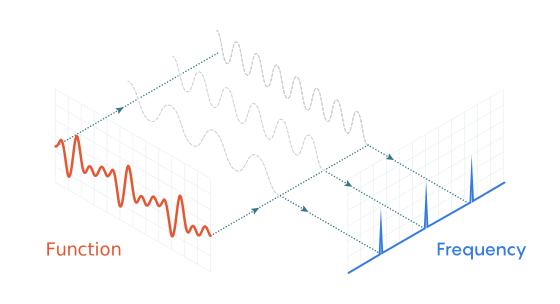
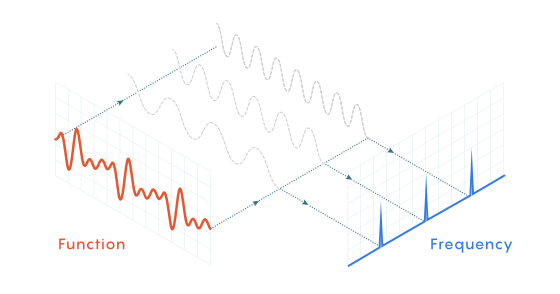
All these uncertainty principles, including the quantum one, arise from the same mathematical source. This deeper mathematical uncertainty principle applies broadly to any function — or any curve, roughly speaking, no matter how bumpy and wild it looks. It comes from an equation invented in the 19th century called the Fourier transform. Named for the Frenchman Joseph Fourier, the Fourier transform decomposes any function into a set of simple waves, each with a different frequency, or tone. Add those simple waves together, and you’ll get back your original function.
Mark Belan/Quanta Magazine
The uncertainty principle comes built in. A simple sine wave, which spreads infinitely throughout space, has one definite frequency, so its Fourier transform is a single peak. But the snap of a snare drum looks like a pulse as it travels through the air. Its Fourier transform has a wide spread of frequencies — a sound with no discernible pitch.
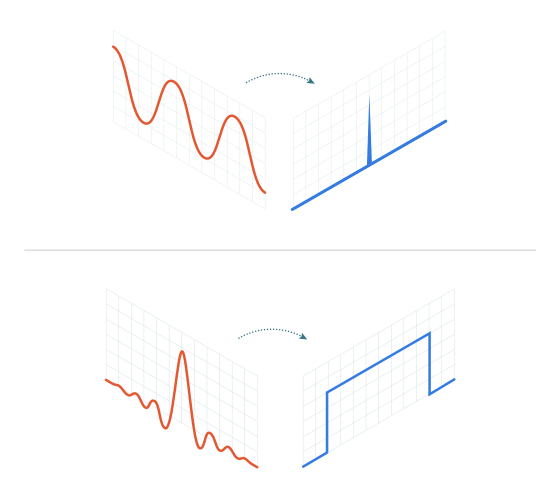
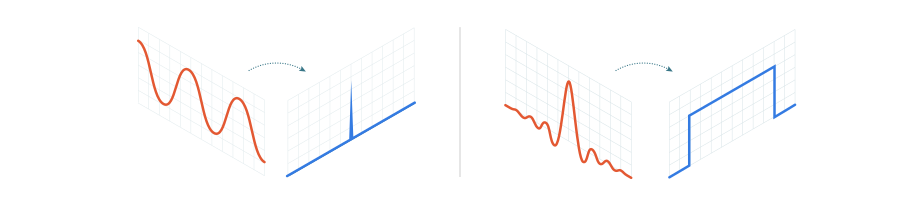
In general, the narrower a function, the more spread out its Fourier transform must be, and vice versa. Or, in other words, the more certain you are about where a function peaks in space, the less certain you can be about its frequency, or how it’s changing in time.
In quantum mechanics, a particle is described mathematically as a wave, with peaks in places where it’s most likely to be found. The Fourier transform of that wave describes the particle’s motion. This is why a quantum particle’s position and momentum can’t both be precisely known at once: They are related by a Fourier transform.
But what if you take the Fourier transform of a function that looks like a fractal?
To make sense of the question, it helps to imagine a simple kind of fractal: Start with a line and cut it into three segments. Then delete the center segment. Repeat the process: Cut each remaining segment into three, remove the center, and so on. The result is a fractal set called the Cantor set. The set has the feature of being what mathematicians call porous — it’s full of holes, like a sponge, at every scale.
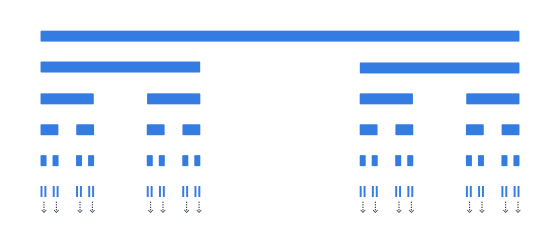
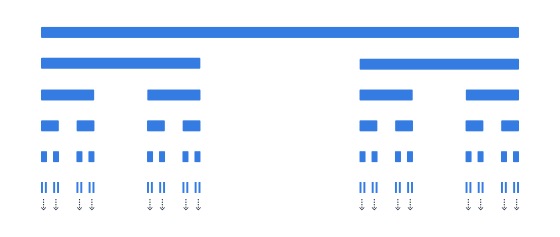
Now imagine that this Cantor set lives on the x-axis, and at each point on this set is a peak representing a frequency.
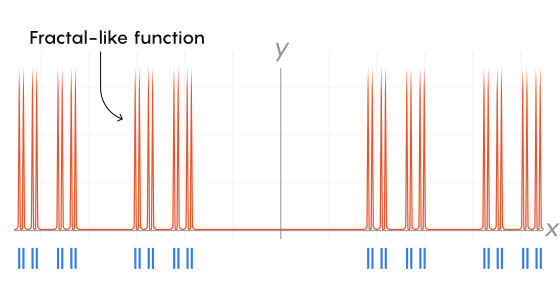
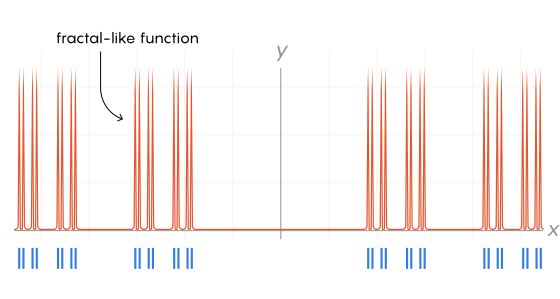
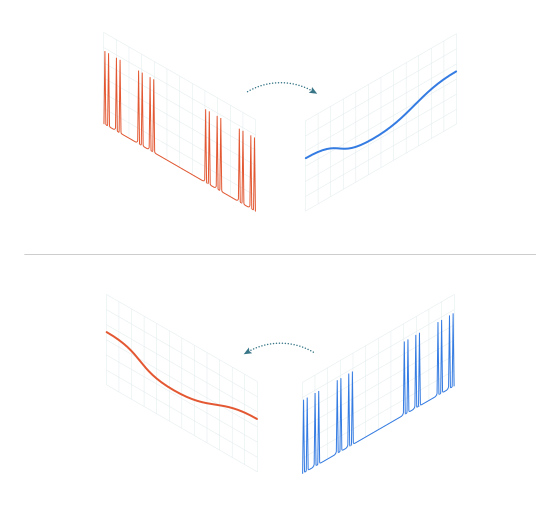
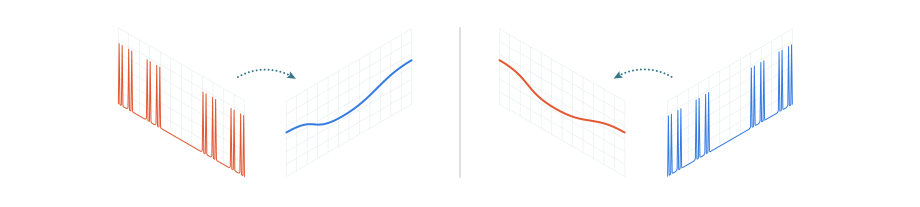
The fractal uncertainty principle says that if you add together waves of that fractal-like set of frequencies, the resulting curve cannot also look like a fractal — it cannot be porous. The reverse also holds: If you take the Fourier transform of a fractal-like function, the result cannot be a fractal-like set of frequencies.
Such fractal-like functions might sound hard to come by. But they pop up when mathematicians study what happens to quantum particles — or waves more generally — in chaotic situations.
Like a ball bouncing around a pinball machine, an object experiencing chaos will often travel erratically around the entire space. “If you look at your path, it’s going to look like a random scribble,” said Elena Kim, a mathematician at Harvard University.
But in rare instances, an object can find stability in the chaos. In a flat pinball machine, a ball could stay trapped bouncing between three bumpers forever. The ball wouldn’t repeat the exact same path, but it would stay confined between the bumpers, bouncing off a slightly different spot each time. And if you marked each spot where the ball hits each bumper, you’d find that the marks make up something like the Cantor set.
This collection of marks is also called fractal dust. Most balls that hit the bumpers will fly off. “This is the dust that’s left,” said Maciej Zworski of the University of California, Berkeley.

Elena Kim, a mathematician at Harvard University, has used the fractal uncertainty principle to understand chaotic systems in unconventional spaces.
Steph Stevens
Unlike a pinball, however, a wave cannot be confined to a fractal-like path, according to the fractal uncertainty principle. If you tried to trap a wave between three bumpers, it would leak out and escape.
“So there’s something different about quantum and classical [chaos],” Dyatlov said. “And one ingredient that you can try to use for that would be uncertainty principles.”
Unfinished Knowledge
Cohen arrived at MIT in 2021 a self-described “young, energetic harmonic analyst” — harmonic analysis being a field of mathematics dedicated to studying functions and their Fourier transforms. As a doctoral student, he sat in Dyatlov’s talks about the fractal uncertainty principle. “He would end every talk being like, ‘We don’t have a higher-dimensional fractal uncertainty principle. I wish we had that!’” Cohen said. “I was like, OK, this seems like a fun thing to work on.”
His enthusiasm was soon checked. For one thing, mathematicians already knew of many situations where the fractal uncertainty principle would fail in higher dimensions. Cohen’s first challenge was to come up with a clean way to avoid these cases.
The typical requirement of being a fractal is to be porous — meaning that there are holes everywhere you look. The two-dimensional fractal called the Sierpiński carpet is an example; it’s built by dividing a square into a grid of smaller squares and removing the middle square, repeatedly. But while this shape has many holes, it’s also possible to draw a straight line that is fully contained within it.
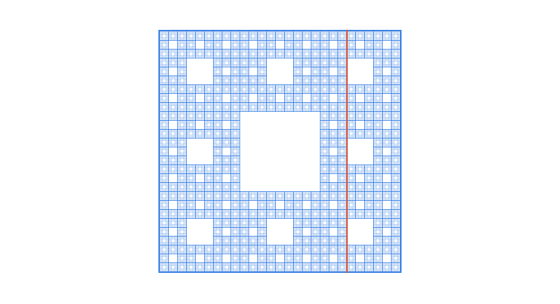
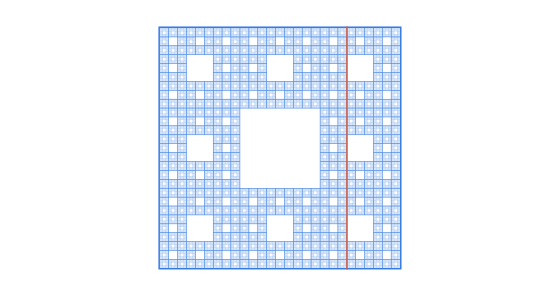
Lines like these spell trouble for the fractal uncertainty principle. The Fourier transform of a vertical line returns a horizontal line, and vice versa. In two or more dimensions, both of these lines count as fractals — that’s because a line takes up no area and leaves most of the surrounding space empty, which satisfies the condition of having many holes. So any fractal that contains uninterrupted lines breaks the fractal uncertainty principle.
Cohen needed a new, more stringent kind of porosity. He came up with what he called “line porosity” — any line you draw on the fractal should encounter many holes. His proof excludes any fractals that don’t have this condition, including the typical Sierpiński carpet, but a modified Sierpiński carpet with much more empty space satisfies the rule.
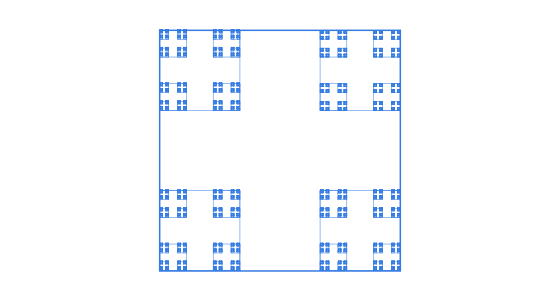
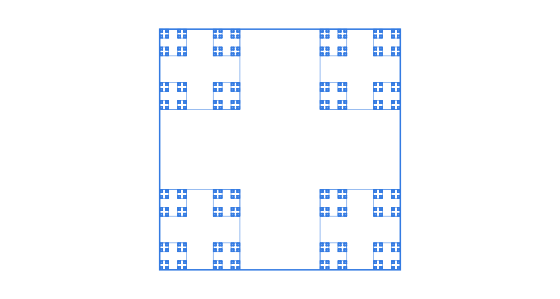
With his assumptions in place, Cohen moved on to the actual proof. He quickly realized that this was unlike any Fourier-related problem he had worked on before. “I tried using all my tools to prove the fractal uncertainty principle, and none of them even came remotely close to working,” he said.
Feeling stuck, he went back to Dyatlov and Bourgain’s proof of the principle in one dimension and sought to understand exactly how it worked.
Dyatlov and Bourgain used an uncommon method in their proof. It involved isolating one peak from a fractal-like function at a time and showing that the Fourier transform of that peak would spread out. Doing this for all peaks, and considering how the Fourier transforms would add together, they proved that the total Fourier transform could never equal zero often enough to form a fractal — there wouldn’t be enough holes.
Isolating each peak required constructing a very specific function that, when multiplied by the original fractal-like function, would pull out just the peak and be close to zero everywhere else. This is called a damping function, and it needs to be perfectly tailor-made to work. “This is a challenging thing to construct,” Cohen said. But he knew that if he could do it in higher dimensions, he could unlock the entire proof.
Cohen consulted Dyatlov about his plan to construct this special function. Before Bourgain died in late 2018, he too struggled with this problem, and he shared his unpublished notes with Dyatlov. Now, Dyatlov shared them with Cohen. “Bourgain was a legendary analyst,” Cohen said. Reading the note felt like “receiving this unfinished knowledge from him.”
The notes contained exactly the hint Cohen needed. “It just blew my mind,” Cohen said. “It really unlocked the problem for me.”
Before reading Bourgain’s note, Cohen had a few ideas for how to construct the damping function, but they were highly complicated and precise, like the designs for building a house brick by brick. The note revealed an unexpected way to do it. It involved taking a detour into complex analysis — the study of functions of imaginary numbers, which include the square root of negative 1. This detour allowed Cohen to build a much more flexible object, which could then be used to construct the damping function indirectly.
Armed with this insight, Cohen then needed to find a way to create just the right version of this flexible object to produce a proper damping function. “To construct something like this that has very specific properties is highly nontrivial. It’s delicate,” said Wilhelm Schlag of Yale University, with whom Cohen studied as an undergraduate. “In two dimensions, nobody knew how to do that, and Alex came up with a brilliant construction of such a thing.”
Cohen stunned the math world when he posted the proof online in May 2023.
“His paper is very beautiful, and it made a huge impression,” Schlag said.
Later, Cohen found out that the trick revealed to him in Bourgain’s note wasn’t actually a secret. The method came from a well-known theorem from the 1960s called the Beurling-Malliavin theorem. “I thought that I had this special inside knowledge,” Cohen said. “I found out later that everyone in the field already knew about this strategy.”
Had he known that his insider tip was no secret, Cohen might have given up too soon. “I think I had a lot of confidence because I didn’t know other people had tried it,” he said.
Funhouse Chaos
Soon after Cohen shared his result, other mathematicians started using it to unlock new proofs about how waves behave in chaotic situations.
In nature, chaos appears in systems like turbulent water and the weather — situations where objects that start close together quickly end up in drastically different places. These systems are too complex to describe mathematically. Instead, mathematicians seeking to study chaos often turn to an odd kind of space that has chaos built in, called hyperbolic space.
In hyperbolic space, parallel lines diverge dramatically, getting farther from each other as you follow their paths. (It’s the opposite of a sphere, where parallel lines converge.) This means that small separations between objects can become huge down the line — the telltale sign of chaos.
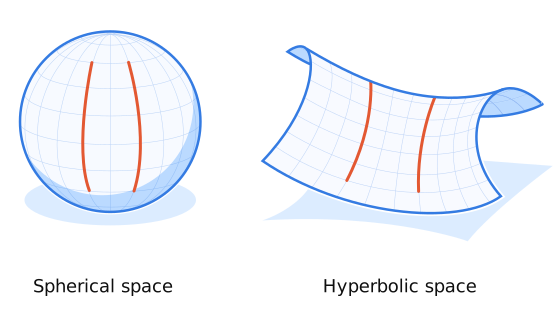
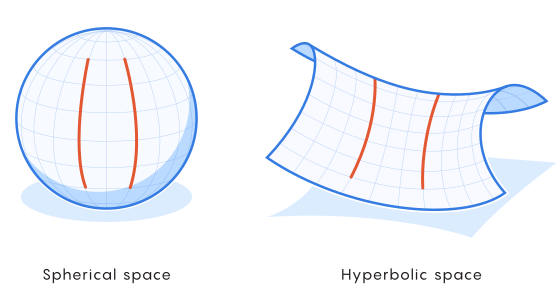
“Of course, this looks nothing like predicting weather,” Dyatlov said. But hyperbolic spaces offer mathematicians a simple chaotic system to explore. “We study what we can handle, and we isolate phenomena. That’s a common thing to do in math.”
In 2017, Dyatlov and Long Jin from Tsinghua University in Beijing used the one-dimensional fractal uncertainty principle to prove that you can never trap a wave on a hyperbolic surface; it will always spread out until it touches every corner.
To do so, they imagined a region on the surface that a wave never enters, even after having infinite time to spread out. When they removed all the trajectories that entered that region, what remained was the same sort of fractal dust that appeared in the pinball example. Since the fractal uncertainty principle forbids a wave from being trapped on a fractal, no such region can exist — the wave must spread everywhere.
In 2025, Kim, along with Nicholas Miller of the University of Oklahoma, used Cohen’s higher-dimensional fractal uncertainty principle to extend the results to hyperbolic spaces of higher dimensions. “That’s the most spectacular application of the higher-dimensional one so far,” Sarnak said.
Many mathematicians are hoping to prove that waves experiencing chaos not only spread out completely but also spread out exactly evenly over the entire space. This is the statement of a famous 1994 conjecture by Sarnak and Zeév Rudnick, who were interested in the problem’s connections to number theory. “This is a huge open conjecture,” Kim said. “It’s a really difficult problem that a lot of people care about.”
Proving this conjecture would show that waves experiencing chaos move in ways that look surprising and random at small scales but are simple at the macroscopic level.
“It’s like those Monet paintings,” Dyatlov said. “When you go very close, they have a lot of microscopic features. There are a lot of brushstrokes.” But if you stand back and squint, “it just looks uniformly colored.” This is different from classical chaos, where objects can get stuck in complicated and detailed paths.
The impact of the fractal uncertainty principle won’t stop with quantum chaos. The tools of Fourier analysis are used in many fields of mathematics and form the backbone of any industry that relies on signal processing. “It’s a foundational fact about Fourier analysis,” Sarnak said. “We haven’t seen all the applications yet.”

Next article
Why Are Rivers So Mathematical?